In the high-stakes world of mergers and acquisitions (M&A), traditional due diligence meticulously scrutinizes financial statements, legal obligations, and market position. However, a new and far more insidious threat now looms over every transaction: the digital Trojan horse of inherited cybersecurity vulnerabilities. Overlooking or inadequately addressing cybersecurity and network security during technical due diligence is no longer a minor oversight; it is a catastrophic failure that can lead to devastating financial, legal, and reputational ruin. A Forescout survey found that a staggering 73% of dealmakers would walk away from a deal if undisclosed cybersecurity issues were discovered [1]. This paper will demonstrate, through exhaustive research, real-world case studies, and statistical evidence, that robust cybersecurity due diligence is not merely an IT checklist item but a core driver of deal value, a critical risk mitigator, and the ultimate determinant of post-acquisition success.

The case studies and data in this report point to a consistent failure: critical cybersecurity risks are missed until after the deal is done—when they are far more expensive to fix.
DownloadIntroduction: The Evolving Role of Technical Due Diligence
Technical due diligence has traditionally focused on assessing the target company’s technology stack, intellectual property, and scalability. However, the digital transformation of virtually every industry has fundamentally altered the risk landscape. Today, most businesses are tech-dependent, data-driven entities, making their cybersecurity posture a primary indicator of their overall health and resilience. The explosion of ransomware, sophisticated supply-chain attacks, and mounting regulatory pressures from bodies like the SEC and the EU’s General Data Protection Regulation (GDPR)have elevated cybersecurity from a secondary concern to a primary pillar of transactional due diligence. Unlike financial irregularities that can be identified on a balance sheet, cyber risks are often invisible, lurking within a target’s network like a “cyber grenade” waiting to detonate post-close [2].
The High Stakes of Cyber Negligence: Why Cybersecurity is a Core Pillar of M&A Due Diligence
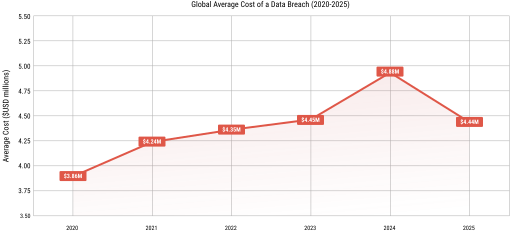
The failure to conduct thorough cybersecurity due diligence can have profound and far-reaching consequences. The average cost of a data breach has surged to $4.88 million in 2024, a figure that can be dwarfed by the costs associated with breaches discovered during or after an M&A transaction [3]. For private equity firms, the average financial impact of a single cyber incident within their portfolio is $2.1 million, with 94% of firms reporting some form of financial loss due to cyber risks [4]. These are not just abstract numbers; they represent tangible threats to deal value and future profitability.
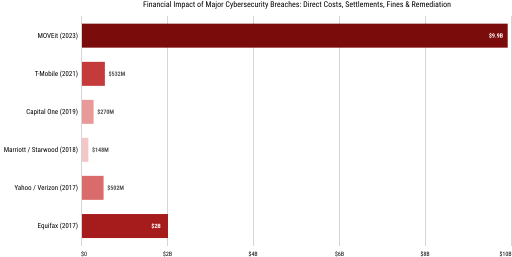
Figure 1: Financial Impact of Major Cybersecurity Breaches
Below are the primary areas of impact:
- Valuation Impact
Undisclosed breaches and weak security controls directly lead to significant price reductions. The landmark Verizon-Yahoo deal saw a $350 million price cut after the disclosure of massive breaches affecting billions of accounts [5]. Similarly, the Forescout-Advent International deal was renegotiated from $1.9 billion down to $1.43 billion [6]. - Financial & Remediation Costs
Acquirers inherit the full cost of remediation, which can be astronomical. Equifax incurred $1.4 billion in costs for cleanup and security upgrades following its 2017 breach [7]. These costs, often discovered post-close, can cripple the financial synergies projected in the deal thesis. - Regulatory & Legal Exposure
Inherited breaches can trigger massive fines and legal battles. In Europe, Marriott inherited a four-year-old breach from its acquisition of Starwood, resulting in an initial ICO fine of £99 million under GDPR for failing to conduct sufficient due diligence [8]. In the United States, the SEC’s new rules mandate disclosure of material cyber incidents within four business days, increasing the legal peril for non-compliant acquirers [9]. - Operational & Integration Risks
The M&A integration period is a moment of heightened vulnerability. Attackers actively target companies during this transition, exploiting distracted IT teams and converging systems. A Kroll report found that 80% of PE firms experienced business disruption from cyberattacks during the hold period [4]. - Reputational & Brand Damage
A post-acquisition breach can irrevocably damage customer trust and brand reputation, leading to customer churn and a decline in stock value. The reputational fallout from the Marriott-Starwood breach was immense, impacting the brand for years.
Engage with software experts to identify and quantify hidden cybersecurity liabilities early to strengthen your position and secure a more accurate deal valuation.
Secure A Better DealDevastating Consequences: Real-World Case Studies in Due Diligence Failure
The theoretical risks of inadequate cyber due diligence are vividly illustrated by a growing list of high-profile corporate disasters. These case studies serve as cautionary tales, demonstrating the tangible and often devastating consequences of acquiring a company without a complete understanding of its cyber posture.
Case Study: Verizon & Yahoo – The $350 Million Price Cut
The acquisition of Yahoo by Verizon is a seminal case study in the financial repercussions of failed cyber due diligence. After agreeing to a $4.83 billion acquisition price, Verizon was forced to renegotiate after Yahoo disclosed two separate, massive data breaches. The first, in 2014, affected 500 million user accounts. The second, a 2013 breach that compromised all three billion of Yahoo’s user accounts, was not fully disclosed until after the deal had closed. The fallout was immediate and severe:
- Price Reduction: The deal value was slashed by $350 million to $4.48 billion [5].
- Regulatory Penalties: The SEC fined Yahoo’s successor company, Altaba, $35 million for failing to disclose the breaches to investors [5].
- Legal Costs: A class-action lawsuit resulted in a $117.5 million settlement [5].
The Yahoo case demonstrated that historical breaches, even those that occurred years prior, represent a clear and present danger to deal value and can introduce massive, unforeseen liabilities.
Case Study: Marriott & Starwood – Inheriting a Multi-Year Cyber Grenade
In 2016, Marriott International acquired Starwood Hotels and Resorts. Two years later, Marriott discovered that Starwood’s guest reservation database had been compromised since 2014, a full two years before the acquisition. The breach exposed the personal data of up to 500 million guests, including highly sensitive information like passport numbers and credit card details. The consequences were catastrophic:
- Massive Regulatory Fines: The UK’s Information Commissioner’s Office (ICO) announced its intention to fine Marriott £99 million ($124 million) under GDPR, explicitly citing the company’s failure to conduct sufficient due diligence on Starwood’s systems [8]. The fine was later reduced to £18.4 million after considering Marriott’s remediation efforts.
- Long-Term Brand Damage: The breach, one of the largest in history, caused significant and lasting damage to the Marriott brand.
This case highlights the principle of “inherited liability” in cybersecurity. An acquirer doesn’t just buy a company’s assets; it also buys its hidden vulnerabilities and historical security failures.
A Pattern of Failure: Equifax, Capital One, and T-Mobile
The list of cautionary tales continues to grow, extending beyond the M&A context but reinforcing the devastating potential of unaddressed vulnerabilities:
- Equifax (2017): A failure to patch a known vulnerability led to a breach affecting 147 million people, costing the company $1.4 billion in cleanup and security upgrades and a global settlement of up to $425 million [7].
- Capital One (2019): A breach affecting over 100 million individuals resulted in a $190 million class-action settlement and an $80 million penalty from the OCC [10].
- T-Mobile (2021): A breach impacting over 53 million individuals led to a $350 million class-action settlement and a commitment to invest an additional $150 million in data security [11].
A Statistical Overview: The Cybersecurity Crisis in M&A
The anecdotal evidence from high-profile breaches is substantiated by alarming industry-wide statistics. The data paints a clear picture of a systemic issue where cyber risk is frequently underestimated, leading to significant value destruction and deal failures.
Figure 2: The Cybersecurity Crisis in M&A, Key Statistics That Demand Attention
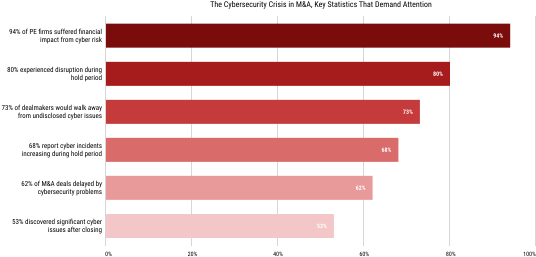
These statistics underscore a critical disconnect in the M&A process. While dealmakers are aware of the threat, the high percentage of issues discovered post-close indicates a widespread failure in the depth and rigor of pre-acquisition due diligence.
Due Diligence: Key Areas to Assess in Cybersecurity & Network Security
To avoid the catastrophic outcomes detailed above, a modern technical due diligence process must incorporate a comprehensive and rigorous assessment of the target’s cybersecurity and network security posture. This assessment should be structured around established frameworks like the NIST Cybersecurity Framework (CSF) and ISO 27001.
The following areas are non-negotiable:
| Assessment Area | Key Objectives & Questions |
|---|---|
| Governance & Policies Evaluate the organization’s cybersecurity framework, including leadership oversight, documented policies, risk management practices, and alignment with recognized standards (e.g., NIST, ISO 27001). |
|
| Technical Controls & Hygiene Assess the effectiveness of core security controls such as access management, endpoint protection, network defenses, patching cadence, and overall system hardening. |
|
| Past Incidents & Breach History Review historical security incidents, response effectiveness, root cause analyses, and any patterns that may indicate systemic weaknesses. |
|
| Third-Party & Supply Chain Risk Examine how the organization vets, monitors, and manages security risks introduced by vendors, partners, and external service providers. |
|
| Attack Surface & Vulnerability Management Identify exposed assets and evaluate processes for detecting, prioritizing, and remediating vulnerabilities across the environment. |
|
| Regulatory Compliance Determine adherence to applicable laws, regulations, and industry requirements (e.g., GDPR, HIPAA), including audit history and any outstanding compliance gaps. |
|
A Tale of Two Markets: The Private Equity Blind Spot
Private equity firms are particularly exposed to the risks of inadequate cyber due diligence. A 2026 Kroll report revealed a stark maturity gap between large firms (>$25B Assets Under Management i.e. AUM) and their smaller counterparts. While 81% of large firms consider cyber due diligence a standard part of their process, only 29% of smaller firms do the same. This disparity creates a significant blind spot in the mid-market, where many acquisitions occur.
Figure 3: The Cyber Maturity Gap: Large vs. Small/Mid-Market PE Firms
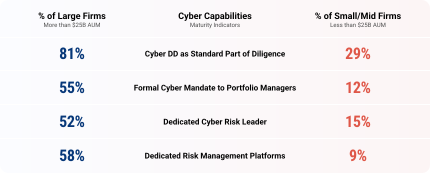
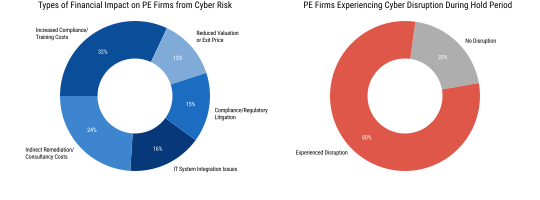
This gap in diligence and governance has real financial consequences. The same Kroll report found that 94% of PE firms have suffered financial losses from cyber incidents in their portfolios, with an average impact of $2.1 million per incident. These losses manifest in various ways, from reduced valuations to unexpected remediation costs and business disruption.
Figure 4: Kroll 2026 Report: Cybersecurity Impact on Private Equity
The Evolving Threat Landscape & Regulatory Environment
The urgency for robust cyber due diligence is amplified by a rapidly evolving threat landscape and an increasingly stringent regulatory environment.
The Rising Tide of Ransomware and Supply Chain Attacks
Modern cyberattacks are more sophisticated and disruptive than ever. The rise of ransomware-as-a-service (RaaS) has democratized the ability to launch crippling attacks, while supply chain attacks like the SolarWinds and MOVEit incidents have demonstrated how a single vulnerability can compromise thousands of organizations. The estimated total cost of the MOVEit attack alone is a staggering $9.9 billion [12].
The Regulatory Hammer
Regulators are no longer giving companies a pass for cybersecurity failures. The legal and financial penalties for non-compliance are severe and growing:
- SEC Cybersecurity Disclosure Rules (2023): Public companies are now required to disclose material cybersecurity incidents within four business days via Form 8-K filings with the SEC, making the information publicly available, and must also provide annual disclosures on their cybersecurity risk management, strategy, and governance [9].
- GDPR: The General Data Protection Regulation carries fines of up to 4% of a company’s global annual turnover for serious infringements. Its extraterritorial scope allows it to apply to companies outside the EU that process the personal data of EU residents, particularly where those companies have operations, customers, or assets tied to the EU, as demonstrated by the Marriott/Starwood case.
- Other Regulations: A patchwork of other regulations, including the California Consumer Privacy Act (CCPA), the EU’s Network and Information Security (NIS2) Directive, and various industry-specific rules (e.g., HIPAA for healthcare), create a complex compliance minefield for acquirers.
Figure 5: Global Average Cost of a Data Breach (2020-2025)
Best Practices: Recommendations for Investors
Integrating cybersecurity due diligence into the M&A lifecycle is not just about finding flaws, it’s about protecting the investment and enabling a secure integration. The following best practices can help investors navigate this complex landscape:
-
Engage Cyber Experts Early
Cybersecurity specialists should be involved from the letter of intent (LOI) stage, not as an afterthought. Their expertise is crucial for identifying red flags and quantifying risks.
-
Adopt a Layered Approach
Due diligence should not rely solely on questionnaires. It must combine policy reviews, interviews with key personnel, and technical assessments (such as vulnerability scans, penetration testing, and dark web reconnaissance) to get a complete picture.
-
Quantify Risk and Adjust Deal Terms
The findings from the due diligence process must be translated into financial terms. This includes estimating the cost of remediation, which can then be used to negotiate a lower purchase price, establish an escrow account, or define specific indemnities.
-
Plan for Integration
The due diligence process should inform the post-merger integration plan. This includes harmonizing security policies, consolidating security tools, and addressing any identified vulnerabilities before they can be exploited during the vulnerable transition period.
-
Recognize the Small/Mid-Market Gap
Research shows a significant gap in cyber risk maturity between large and small/mid-market firms. Acquirers targeting smaller companies must be prepared for a lower level of security maturity and factor that into their risk assessment and integration planning [4].
Conclusion: A Non-Negotiable Imperative
In the digital age, every acquisition is a technology acquisition, and every technology acquisition carries inherent cyber risk. The evidence is clear and overwhelming: ignoring, underestimating, or improperly conducting cybersecurity and network security due diligence is a recipe for disaster. The financial and reputational damage from an inherited breach can dwarf the initial cost of the transaction, turning a strategic investment into a catastrophic liability. For PE firms, corporate development teams, and investment bankers, making robust cyber due diligence a non-negotiable component of every transaction is not just a best practice—it is an absolute imperative for survival and success in the modern M&A landscape.