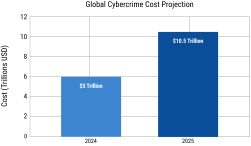
Artificial Intelligence (AI) is no longer a theoretical concept in cybersecurity; it has become a formidable weapon. This paper examines the new and alarming wave of AI-generated cyber attacks that are reshaping the global threat landscape. We analyze the impact of these sophisticated threats across five critical sectors: personal privacy, finance, healthcare, cryptocurrency, and national security. Drawing on verifiable data from 2024 and 2025, this research quantifies the escalating economic damage, with cybercrime costs projected to reach an unprecedented $10.5 trillion annually by 2025 [1]. The findings reveal a significant “AI governance gap,” where the rapid, often ungoverned, adoption of AI has left organizations dangerously exposed. For instance, 97% of organizations that suffered an AI-related security incident lacked proper AI access controls [2].
This paper argues that without immediate and substantial investment in AI-powered defenses, robust governance frameworks, and workforce upskilling, the future of our digital infrastructure is not bright. We present a comprehensive analysis supported by twelve data visualizations that illustrate the scale of the threat and the urgency of the required response. The paper concludes with strategic recommendations for industry leaders, policymakers, and cybersecurity professionals to mitigate these existential risks and build a more resilient digital future.

AI-driven cyber attacks are emerging as a material investment risk. This white paper examines where governance failures, escalating attack sophistication, and rising costs may create hidden downside across portfolios.
DownloadIntroduction
The digital age has entered a new, more perilous era. The rapid proliferation and democratization of powerful Artificial Intelligence (AI) tools have triggered a paradigm shift in the nature of cyber warfare. What was once the domain of highly skilled, state-sponsored actors is now accessible to a broader range of malicious entities, creating a new shockwave of AI-generated cyber attacks. These are not merely incremental improvements on old methods; they represent a quantum leap in the speed, scale, and sophistication of cyber threats. From hyper-realistic deepfakes designed to defraud financial institutions to autonomous malware that adapts in real-time to breach defenses, AI is supercharging the capabilities of cybercriminals and hostile nation-states.
The consequences of this new reality are already being felt across the globe. In 2024 alone, the FBI logged over $16 billion in losses from cybercrime [3], a figure that only scratches the surface of the true economic devastation. Projections indicate that the global cost of cybercrime will surge to an astronomical $10.5 trillion annually by 2025 [1], a sum that would make it the world’s third-largest economy after the United States and China. This is not a distant threat; it is a clear and present danger that is actively undermining economic stability, personal security, and national sovereignty.
Figure 1: A comparison of the supply-side recreation cost and the demand-side replacement value of the open source ecosystem, highlighting the immense value disparity. Data Source: Hoffmann, Nagle & Zhou, 2024
This research paper provides a comprehensive and sophisticated analysis of this new wave of AI-generated cyber threats. It moves beyond sensationalism to deliver a fact-based, data-driven examination of the challenges we face. The paper is structured to provide a multi-faceted view of the problem, covering the following key areas:
- Sector-Specific Threat Analysis: A deep dive into the unique ways AI-powered attacks are impacting personal privacy, the financial sector, healthcare, cryptocurrency markets, and national security.
- The Economic Imperative: A detailed breakdown of the staggering financial costs associated with these attacks and a compelling case for why significant investment in next-generation cybersecurity is not just a recommendation, but a necessity for survival.
- The AI Governance Gap: An exploration of the critical disconnect between the rapid adoption of AI technologies and the lack of corresponding security governance and preparedness within organizations.
- Data-Driven Insights: The presentation of twelve original data visualizations, created from the latest research and statistics, to provide a clear and accessible understanding of the threat landscape.
This paper serves as both a warning and a call to action. The future is not bright if we continue on our current trajectory. The industry, from individual organizations to national governments, must recognize the gravity of the situation and commit to a new level of investment and collaboration. The following sections will lay out the evidence in stark detail, making the case for a fundamental shift in our approach to cybersecurity in the age of AI.
Personal Privacy and the Rise of AI-Powered Social Engineering
The erosion of personal privacy is one of the most immediate and widespread consequences of the AI-driven cyber threat landscape. Malicious actors are leveraging AI to automate and enhance social engineering attacks on an unprecedented scale, making them more personalized, believable, and effective than ever before. This has led to a dramatic increase in identity theft, fraud, and the unauthorized exposure of sensitive personal data.
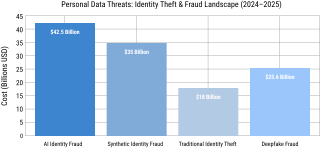
The statistics are alarming. In 2024, a record-breaking 276.8 million individuals had their protected health information (PHI) exposed or stolen [4], and the average cost of a data breach reached an all-time high of $4.45 million in 2023 [5]. The advent of AI has only exacerbated this trend. AI identity fraud now accounts for 42.5% of all detected attempts, costing businesses billions [6]. Furthermore, losses from synthetic identity fraud, where criminals create entirely new identities using a combination of real and fake information, surpassed $35 billion in 2023 [7].
Figure 2: The landscape of identity theft and fraud, highlighting the significant financial impact of AI-driven methods. Sources: Signicat [6], Boston Fed [7].
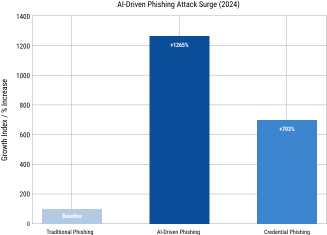
AI-powered tools are enabling attackers to craft highly convincing phishing emails, text messages, and even voice calls. These are no longer the generic, poorly worded messages of the past. Modern AI can analyze a target’s social media presence, professional background, and personal interests to create tailored messages that are almost indistinguishable from legitimate communications. This has resulted in a staggering 1,265% increase in AI-driven phishing attacks and a 703% rise in credential phishing in the latter half of 2024 alone.
Figure 3: The dramatic surge in AI-driven phishing attacks in 2024, demonstrating the increased effectiveness of these methods. Source: Tech-Adv [8].
The psychological impact on individuals is also significant. A recent survey found that 92% of Baby Boomers, 86% of Gen X, and 81% of Millennials are anxious about AI-assisted identity theft [9]. This widespread fear is not unfounded. The ease with which AI can be used to create deepfake videos and audio further amplifies the threat, making it possible to impersonate individuals with terrifying accuracy. The consequences for personal reputation, financial well-being, and mental health are profound.
This new reality demands a fundamental shift in how we approach personal data protection. Individuals must become more vigilant, and organizations must implement more robust security measures, including multi-factor authentication, advanced email filtering, and continuous employee training. However, the ultimate solution lies in a combination of technological innovation and stronger regulatory frameworks that hold organizations accountable for the protection of personal data in the age of AI.
Quandary Peak Research helps organizations assess how AI-driven attack techniques, governance gaps, and system-level vulnerabilities translate into real operational, financial, and security exposure.
Get StartedThe Healthcare Sector: A System in Critical Condition
The healthcare sector has become a prime target for AI-powered cyber attacks, with devastating consequences for patient safety, data privacy, and the operational stability of healthcare providers. The sensitive nature of health information, combined with often outdated and underfunded IT infrastructure, makes this sector particularly vulnerable. The result is a system in critical condition, struggling to defend against an onslaught of sophisticated threats.
In 2024, the healthcare sector witnessed an unprecedented wave of data breaches, with the protected health information (PHI) of a staggering 276.8 million individuals being exposed or stolen [4]. This equates to an average of over 758,000 records being compromised every single day [4]. The financial repercussions are equally severe, with the average cost of a data breach in healthcare reaching $10.3 million, the highest of any industry [13].
- 276.8M Individuals Affected
- 758.3K Daily Records Exposed
- $10.3M Average cost of Breach
- +30% Ransomware Increase
Ransomware attacks, supercharged by AI, have become a particularly acute problem. In 2025, the healthcare sector saw a 30% surge in ransomware attacks [14]. These are not just data theft incidents; they are direct attacks on patient care. When hospital systems are taken offline, surgeries are canceled, appointments are postponed, and medical records become inaccessible, putting patient lives at risk. While the average ransom demand has plummeted by 91% to $343,000 [15], the sheer volume of attacks has increased, indicating a shift in tactics towards a higher frequency of smaller, more disruptive attacks.
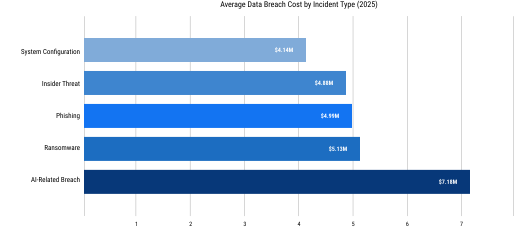
Figure 4: In 2025, AI-related breaches are the most costly on average (about $7.18M per incident), followed by ransomware, insider threats, phishing, and system misconfigurations, all clustered around $4–5M.
The adoption of AI within healthcare also introduces new vulnerabilities. Healthcare workers are increasingly using generative AI tools for tasks such as summarizing patient notes, but often without proper security safeguards, leading to potential HIPAA violations [16]. Patients themselves are also inadvertently contributing to the problem by uploading their medical records to public AI chatbots, creating new avenues for data exposure [17].
The industry’s reliance on a complex web of third-party vendors and service partners further expands the attack surface. Cybercriminals are increasingly targeting these vendors as a weak link to gain access to the networks of multiple healthcare providers. This was a key trend in 2025, with attacks on healthcare providers themselves decreasing by 8%, while attacks on their vendors surged [14].
Addressing this crisis requires a multi-pronged approach. Healthcare organizations must urgently modernize their IT infrastructure, invest in AI-powered security solutions, and provide comprehensive cybersecurity training to all staff. Regulators must also strengthen data protection requirements and enforce stricter penalties for non-compliance. Without these measures, the healthcare sector will remain a vulnerable and attractive target for AI-driven cybercrime, with potentially life-threatening consequences.
Cryptocurrency: The New Wild West of AI-Powered Heists
The decentralized and often pseudonymous nature of cryptocurrency has always made it an attractive target for cybercriminals. However, the integration of AI into the attacker’s toolkit has transformed this burgeoning financial landscape into a new Wild West, where digital heists are executed with unprecedented speed and sophistication. The scale of theft is staggering, and the security of the entire ecosystem is being called into question.
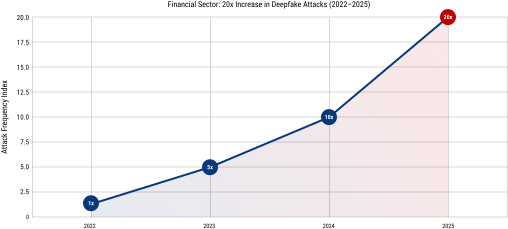
Figure 5: A dramatic 20× increase in deepfake attacks in the financial sector from 2022 to 2025, highlighting the rapid escalation of AI-driven fraud threats.
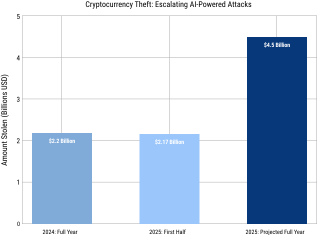
The financial losses are escalating at an alarming pace. In the first half of 2025 alone, over $2.17 billion was stolen from cryptocurrency services, a figure that already eclipses the $2.2 billion stolen in the entirety of 2024 [18]. This indicates a significant acceleration in the frequency and severity of attacks. The average loss per incident has more than doubled, jumping from $3.1 million in 2024 to $7.18 million in 2025 [19], demonstrating the increased effectiveness of AI-powered attack methods.
AI is being leveraged in a multitude of ways to compromise cryptocurrency platforms and defraud investors. AI-driven bots are used to execute complex phishing scams, create fake social media profiles to promote fraudulent projects, and even generate deepfake videos of prominent figures in the crypto community to lend legitimacy to their schemes. A recent study by Anthropic revealed that AI models are now capable of independently discovering and exploiting vulnerabilities in smart contracts, the self-executing code that underpins many decentralized finance (DeFi) applications. In a simulated environment, these AI agents were able to generate $4.6 million in stolen funds by hacking smart contracts [20].
Figure 6: A comparison of cryptocurrency theft in 2024 and the first half of 2025, with a projection for the full year, illustrating the dramatic increase in AI-powered heists. Sources: Chainalysis [18], Infosecurity Magazine [19].
Attackers are also targeting the very infrastructure of the AI ecosystem to fuel their crypto-related crimes. In one notable example, hackers exploited a critical vulnerability in Ray, a popular open-source AI framework, to launch widespread cryptojacking campaigns, hijacking the computational resources of their victims to mine cryptocurrency.
The primary vectors for these attacks are often weaknesses in the security of cryptocurrency exchanges and DeFi platforms. Access control exploits accounted for over $1.8 billion of the losses in the first half of 2025, while phishing scams were responsible for another $594.1 million [21]. The rapid pace of innovation in the crypto space often outstrips the development of robust security protocols, creating a fertile ground for attackers.
To combat this escalating threat, the cryptocurrency industry must prioritize security in a way it has not done before. This includes rigorous auditing of smart contracts, the adoption of AI-powered threat detection systems, and a greater emphasis on user education. The decentralized promise of cryptocurrency can only be realized if the ecosystem can prove itself to be a safe and secure environment for users and investors. Without a concerted and well-funded effort to bolster defenses, the Wild West of AI-powered crypto heists will only become more dangerous.
National Security: The Dawn of Autonomous Cyber Warfare
The weaponization of AI by nation-states and their proxies represents a fundamental shift in the landscape of international conflict and national security. We are witnessing the dawn of autonomous cyber warfare, where AI-driven attacks can be launched with a level of speed, scale, and precision that was previously unimaginable. This new reality poses an existential threat to critical infrastructure, military operations, and the very foundations of democratic societies.
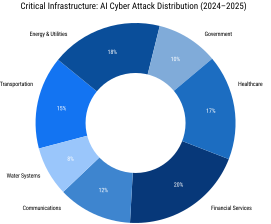
Critical infrastructure—the energy grids, water systems, transportation networks, and communication systems that form the backbone of modern nations—is now firmly in the crosshairs of AI-powered adversaries. In 2024, an alarming 70% of all cyberattacks targeted critical infrastructure [22]. State-sponsored attackers are increasingly deploying “agentic AI” cyberweapons, autonomous systems that can independently identify vulnerabilities, develop exploits, and execute attacks with minimal human intervention [23].
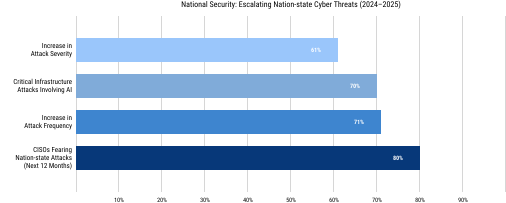
Figure 7: The escalating perception of nation-state cyber threats among cybersecurity leaders, highlighting the growing fear of AI-powered attacks on critical infrastructure. Sources: VikingCloud, US Homeland Security Committee [25].
The threat is no longer theoretical. A recent report from Anthropic detailed the first known case of an AI-orchestrated cyber espionage campaign, where the threat actor was able to use AI to perform 80–90% of the campaign’s tasks, with only sporadic human intervention required [24]. This level of automation dramatically lowers the barrier to entry for sophisticated attacks and allows hostile nations to conduct multiple, simultaneous campaigns against their adversaries.
The perception of this threat is growing rapidly within the cybersecurity community. Nearly 80% of cybersecurity leaders now fear their organization could be the target of a nation-state cyberattack within the next 12 months [25]. This fear is well-founded, with 71% reporting an increase in the frequency of attacks and 61% reporting an increase in their severity over the past year [25].
The implications for military operations are also profound. The Pentagon has recognized that cyber warfare poses a significant threat to the joint force, and AI is at the heart of this new battlespace [26]. AI-powered attacks can be used to disrupt command and control systems, compromise weapons platforms, and spread disinformation to undermine military and civilian morale. The 2025 conflict between Israel and Iran has already provided a glimpse into the future of asymmetric cyber warfare, where AI is used to fundamentally alter the calculus of offense and defense [27].
Figure 8: The distribution of AI-powered cyber attacks across various critical infrastructure sectors in 2024-2025, with the financial services and healthcare sectors being the most targeted.
Defending against this new generation of autonomous cyber threats requires a paradigm shift in national security strategy. Governments must foster closer collaboration between intelligence agencies, the military, and the private sector to share threat intelligence and develop coordinated defense strategies. Investment in AI-powered defensive systems, quantum-resistant cryptography, and a highly skilled cybersecurity workforce is no longer optional; it is a national security imperative. The future of global stability may well depend on our ability to win this new, AI-driven arms race.
The AI Governance Gap and the Investment Imperative
The unprecedented wave of AI-generated cyber attacks is not solely a result of technological advancements in the hands of malicious actors. It is also a direct consequence of a critical and widening “AI governance gap” within organizations across all sectors. The rush to adopt AI technologies, driven by the promise of competitive advantage and operational efficiency, has far outpaced the development of robust security and governance frameworks. This has created a fertile ground for exploitation, leaving organizations dangerously exposed to the very threats they are trying to combat.
The statistics paint a stark picture of this unpreparedness. A staggering 97% of organizations that reported an AI-related security incident in 2025 admitted to lacking proper AI access controls [2]. Furthermore, 63% of organizations lacked any formal AI governance policies to manage the use of AI or prevent the proliferation of “shadow AI”—the unsanctioned use of AI tools by employees [2]. This lack of oversight means that many organizations are flying blind, unaware of the full extent of their AI-related vulnerabilities.
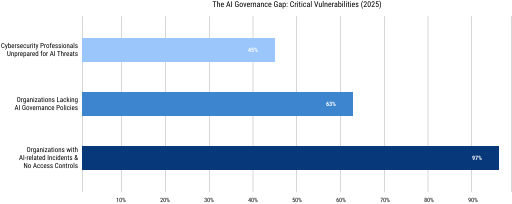
Figure 9: The critical AI governance gap within organizations, highlighting the high percentage of unpreparedness for AI-powered threats. Source: IBM [2].
This governance deficit is compounded by a persistent shortage of skilled cybersecurity professionals. “Insufficient personnel” is cited as the greatest inhibitor to defending against AI-powered threats, yet only 11% of organizations are prioritizing the hiring of new cybersecurity staff over the next 12 months [28]. This creates a dangerous paradox: as the threat landscape becomes exponentially more complex, the human resources dedicated to managing it are not keeping pace.
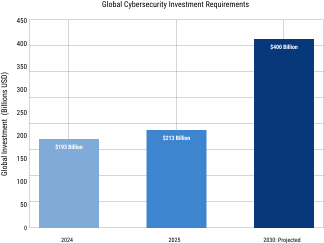
The solution to this multifaceted problem lies in a two-pronged approach: a radical commitment to closing the AI governance gap and a massive, sustained investment in next-generation cybersecurity. The economic case for this investment is undeniable. As previously noted, the global cost of cybercrime is projected to reach $10.5 trillion annually by 2025 [1]. In contrast, global spending on cybersecurity is forecast to reach $213 billion in the same year [29]. While this represents a 15% increase from 2024, it is a mere fraction of the potential losses.
Figure 10: The projected growth in global cybersecurity investment, which still pales in comparison to the potential economic damage from cybercrime. Source: Gartner [29].
Organizations that have already embraced AI in their security operations are seeing a significant return on investment. Those with extensive use of AI in security have reported cost savings of $1.9 million per data breach compared to those that have not [2]. This demonstrates that the very technology being used by attackers is also our most powerful weapon in defense.
Closing the AI governance gap requires a top-down commitment from organizational leadership. This includes:
- Establishing a clear AI governance framework: This framework must define acceptable use policies, data privacy standards, and security protocols for all AI systems used within the organization.
- Investing in AI-powered security tools: These tools can automate threat detection, analysis, and response, freeing up human analysts to focus on the most critical threats.
- Upskilling the workforce: Continuous training and education are essential to ensure that all employees, from the C-suite to the front lines, are aware of the latest AI-driven threats and how to mitigate them.
The investment imperative is clear. The future of our digital society depends on our ability to close the gap between the promise of AI and the peril it represents. The cost of inaction is a price we cannot afford to pay.
Conclusion: A Call to Action for a Resilient Future
The evidence presented in this paper is unequivocal: we are at a critical inflection point in the history of cybersecurity. The new shockwave of AI-generated cyber attacks is not a future problem; it is a present and escalating crisis that threatens the stability of our global economy, the integrity of our democratic institutions, and the safety of our personal lives. From the hyper-personalized social engineering attacks that erode individual privacy to the autonomous cyberweapons targeting our most critical national infrastructure, AI has fundamentally and irrevocably altered the threat landscape.
The data speaks for itself. With cybercrime costs projected to reach $10.5 trillion annually by 2025 [1], the economic consequences of inaction are catastrophic. The significant “AI governance gap” within organizations, where 97% of those breached lack proper AI access controls [2], highlights a systemic failure to keep pace with the rapid weaponization of this technology. The healthcare sector is in critical condition, the financial sector is a high-stakes battleground, the cryptocurrency market is a new Wild West, and our national security is facing the dawn of autonomous cyber warfare.
However, this paper is not intended to be a message of despair, but rather an urgent and emphatic call to action. The same AI that powers these sophisticated attacks also holds the key to our defense. We have the tools and the knowledge to build a more resilient digital future, but we lack the collective will and the necessary investment to do so at the scale required.
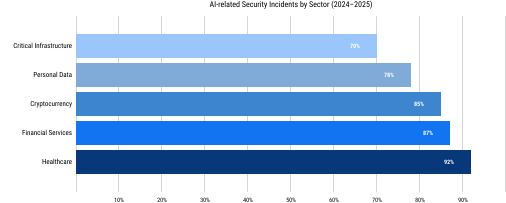
Figure 11: The widespread impact of AI-related security incidents across various sectors, underscoring the universal nature of the threat. Sources: SoSafe, Darktrace, US Homeland Security Committee.
This paper concludes with the following strategic recommendations for leaders across all sectors:
-
Prioritize AI Governance
Every organization must immediately establish a robust AI governance framework that includes clear policies, strong access controls, and continuous monitoring of all AI systems.
-
Invest in AI-Powered Defense
The fight against AI-driven attacks can only be won with AI-powered defenses. Organizations must invest in next-generation security solutions that can automate threat detection, analysis, and response in real-time.
-
Foster Public-Private Collaboration
Governments, intelligence agencies, and private sector companies must forge deeper partnerships to share threat intelligence and develop coordinated defense strategies, particularly for the protection of critical infrastructure.
-
Commit to Workforce Upskilling
The human element remains our most valuable asset. We must invest in continuous training and education to equip our cybersecurity workforce with the skills needed to combat the evolving threat landscape.
The future is not yet written. We have a choice to make. We can continue on our current path of reactive, underfunded, and fragmented security measures, and suffer the inevitable consequences. Or, we can rise to the challenge, embrace the transformative power of AI for both innovation and defense, and collectively invest in building a safer, more secure, and more prosperous digital world for generations to come. The time to act is now.